
Process / continuous
ERP for Textile Mills
Shade matching, 4-point inspection and B-grade that still sells. A system that only knows A-grade and scrap cannot cost a textile mill.
- Stages mapped
- 6
- Quality checks
- 4
- Wastage rules
- 3
- Compliance items
- 3
Your process
The stages, already mapped.
Yarn to finished fabric with lot tracking. These are the stages the template ships with — machines and checks included. Yours will differ in detail; that is configuration, not development.
- 1
Warping
Prepare warp beams from yarn lots with tension control
- Machines
- Warper
- Checked
- End breaks/1000m
- 2
Sizing
Apply size for weaving strength
- Machines
- Sizing machine
- Checked
- Size pickup %
- 3
Weaving
Weave fabric on looms with stop-cause logging
- Machines
- Airjet looms ×24
- Checked
- On-loom inspection
- 4
Inspection
4-point grading of grey fabric
- Machines
- Inspection frame
- Checked
- Points/100 m²
- 5
Processing / dyeing
Dye and finish to shade with lab-dip approval
- Machines
- Jet dyeing, stenter
- Checked
- Shade ΔE, GSM
- 6
Folding & baling
Roll/fold, grade and pack for dispatch
- Machines
- Folder, baler
- Checked
- Length, grade tag
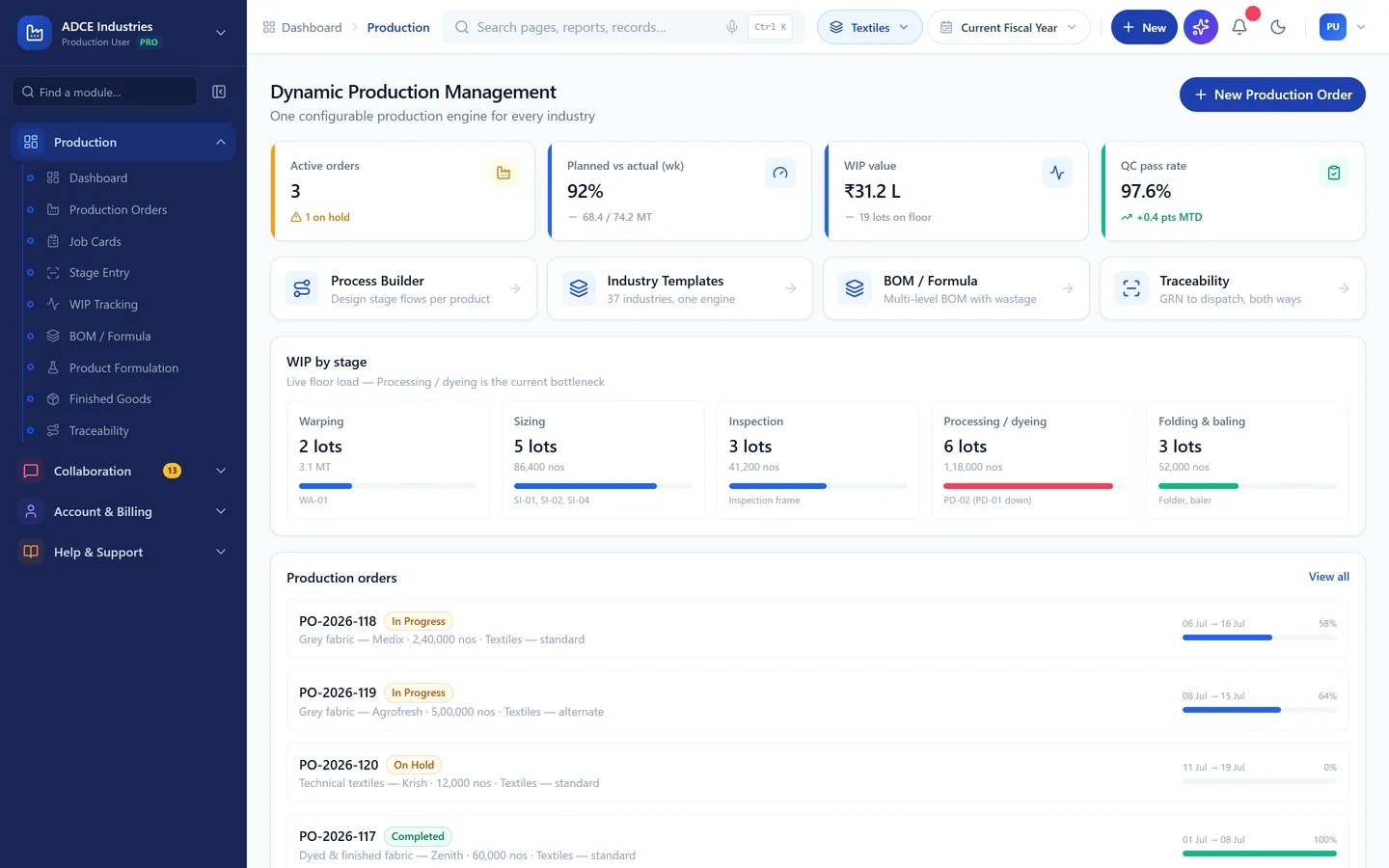
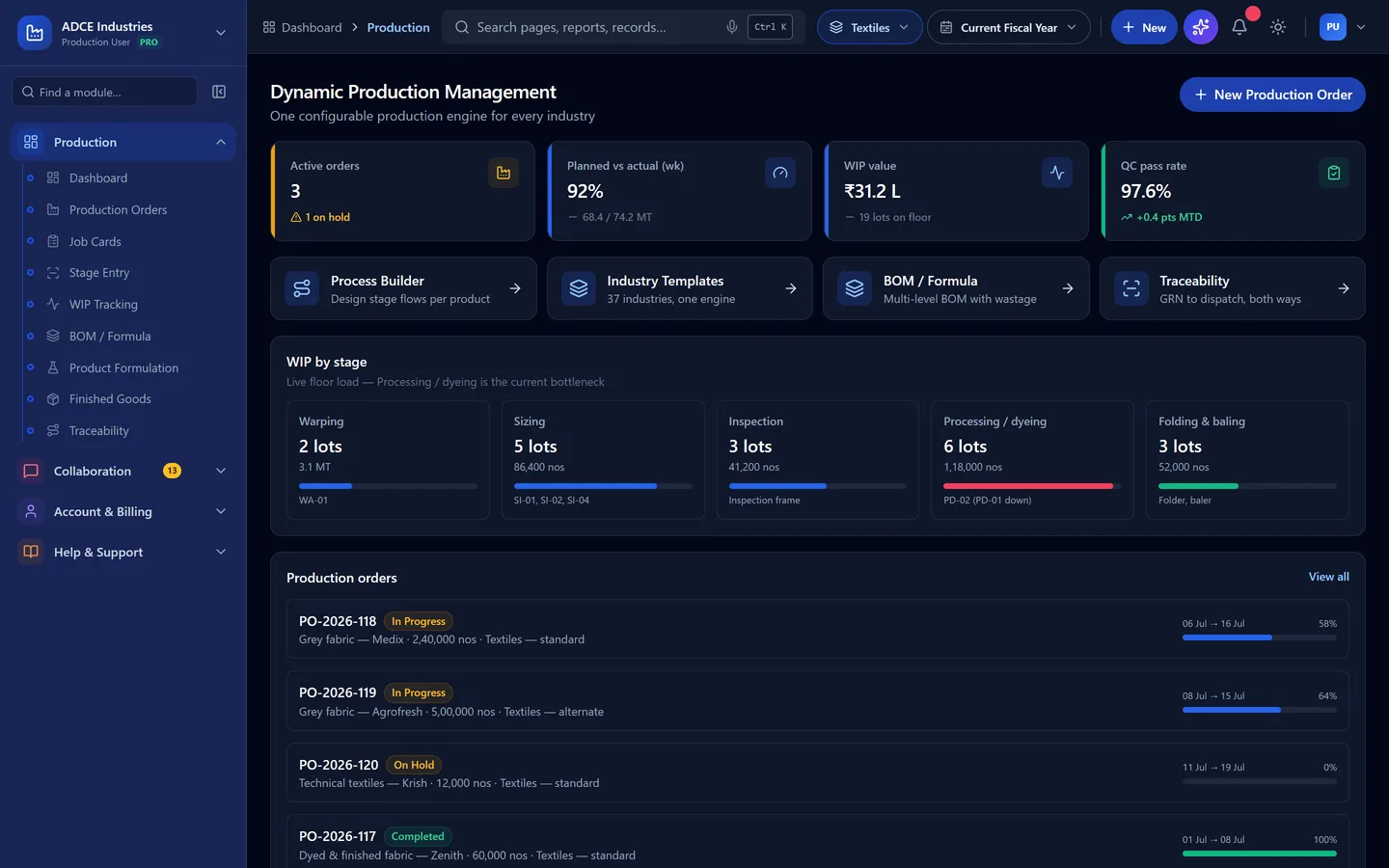
What goes in
Yarn lots, dyes, chemicals
What comes out
Grey & finished fabric
Grey fabric · Dyed & finished fabric · Technical textiles
Who is it for
Not all textile mills work the same way.
The template is the same; what it has to answer for is not. Find the one that sounds like you — if none of them do, say so on the call and we will tell you honestly whether this is the right fit.
Spinning mills
Count-wise production, mixing costs and waste percentages.
Weaving & knitting units
Loom-wise output, beam and yarn issue, sort-wise costing.
Processing houses & dye units
Lot-wise shade approval, re-process and shrinkage.
Job-work weavers on customer yarn
Challan in, challan out, rate per metre.
MANUPRIME AI
Ask it about this floor, in your own words.
The AI reads the same records this template creates — so on a textile mill floor the questions it can actually answer are the ones you already ask at the morning meeting.
Questions it answers here
- “Why has loom efficiency moved this week?” — currently 88% in the demo data
- “Why has right-first-time dyeing moved this week?” — currently 91% in the demo data
- “Why has b-grade % moved this week?” — currently 2.4% in the demo data
- “Where is my wastage going?” — selvedge, fents, b-grade, costed back to the batch that caused it
- “What am I short of in the next 14 days?” — with the covering purchase order drafted for approval
And what it is not allowed to do
It shows its working, or it does not answer
It drafts. A person releases
It sees only what the person asking can see
Quality
What quality control looks like here.
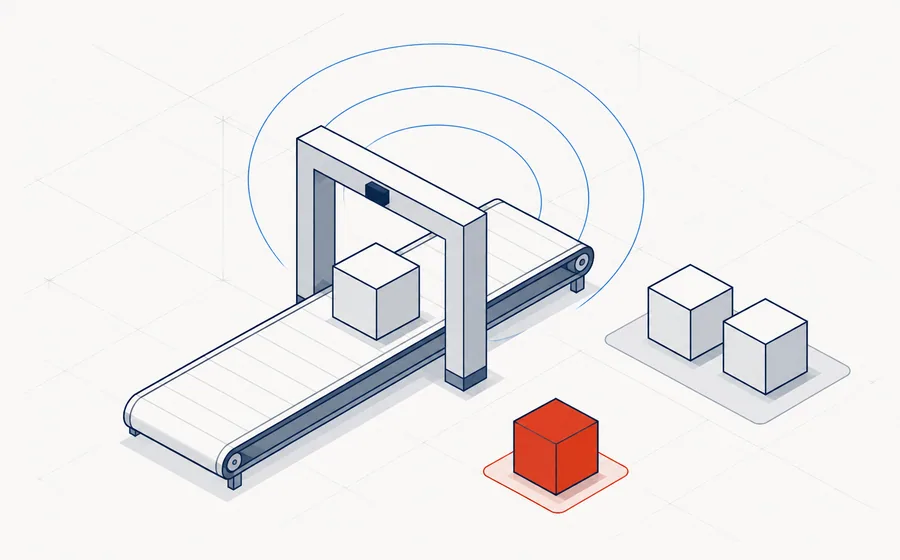
Checks that hold a dispatch, at the frequency this trade actually inspects.
| Parameter | Method | Frequency |
|---|---|---|
| Fabric defects | 4-point system | 100% inspection |
| Shade match | Spectrophotometer ΔE | Per dye lot |
| GSM | GSM cutter + balance | Per lot |
| Colour fastness | Wash/rub test | Per shade |
Wastage and recovery
The part generic ERPs get wrong.
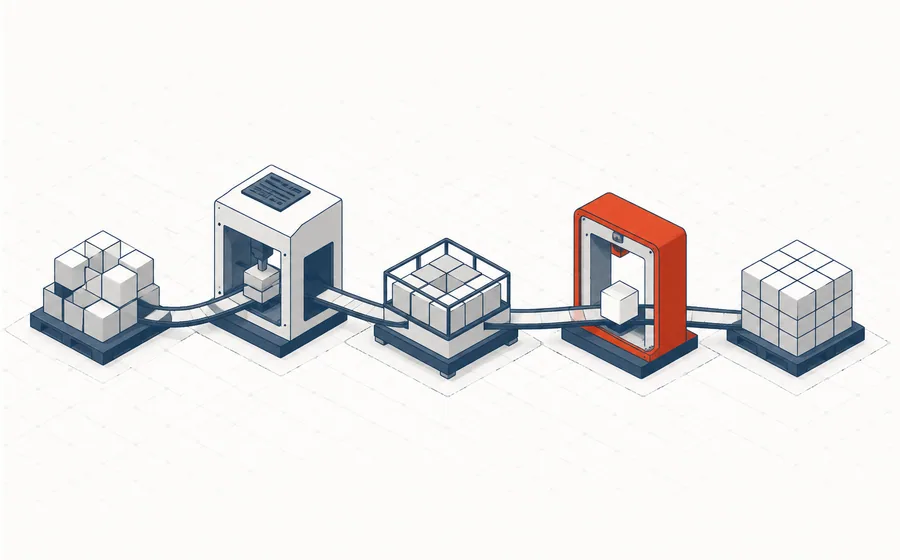
Most systems can only write material off. In this trade that is the difference between a costing you believe and one you argue with.
Rules that ship with this template
- Selvedge & fents sold by weight
- B-grade fabric priced per grade matrix
- Re-dye lots limited to 1 pass
What drives your cost per unit
- Yarn cost per count with lot variance
- Loom-hour rate (picks-based)
- Dyes & chemicals per kg fabric
In short:Selvedge, fents, B-grade.
Compliance
What this trade has to prove.
Configured, not bolted on afterwards — the records come out of the same transactions your floor is already entering.
On the dashboard
The numbers this plant is judged on.
Sample figures from the demo, so you can see the shape of what you would be looking at every morning.
- Loom efficiency
- 88%
- Right-first-time dyeing
- 91%
- B-grade %
- 2.4%
Illustrative values from the demo dataset, not a customer's figures.
Questions
Questions we get asked first.
Does it handle grading and B-grade sale?
Yes. Inspection assigns a grade, and each grade is a saleable item at its own rate. Seconds are inventory, not a write-off.
Can we track shade lots?
Dye lots carry their own identity through processing, and picking can be restricted to a single shade lot for an order so the customer does not get two shades in one delivery.
How is 4-point inspection recorded?
As the inspection plan on the fabric roll, with points per defect type, and the roll is graded from the total. The inspection sheet prints for the customer.
See it running with Textiles data.
The demo opens with this trade's materials, machines, checks and reports already in place. No signup, nothing to install.