
Batch / recipe
ERP for Food & Beverage Manufacturers
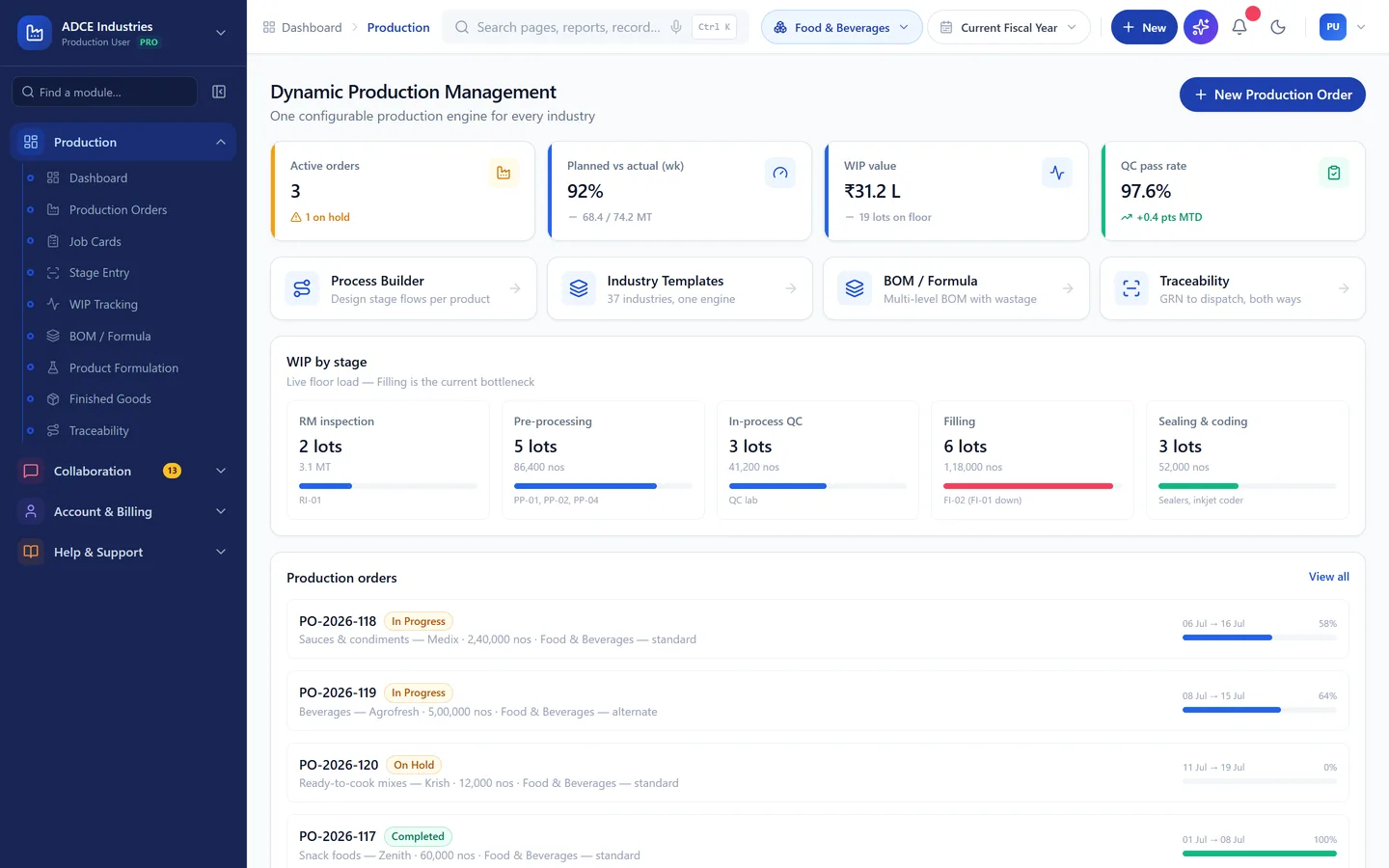
FEFO is not optional, a recall has to run in both directions in minutes, and process loss between the kettle and the carton is where the margin goes.
- Stages mapped
- 7
- Quality checks
- 4
- Wastage rules
- 3
- Compliance items
- 3
Your process
The stages, already mapped.
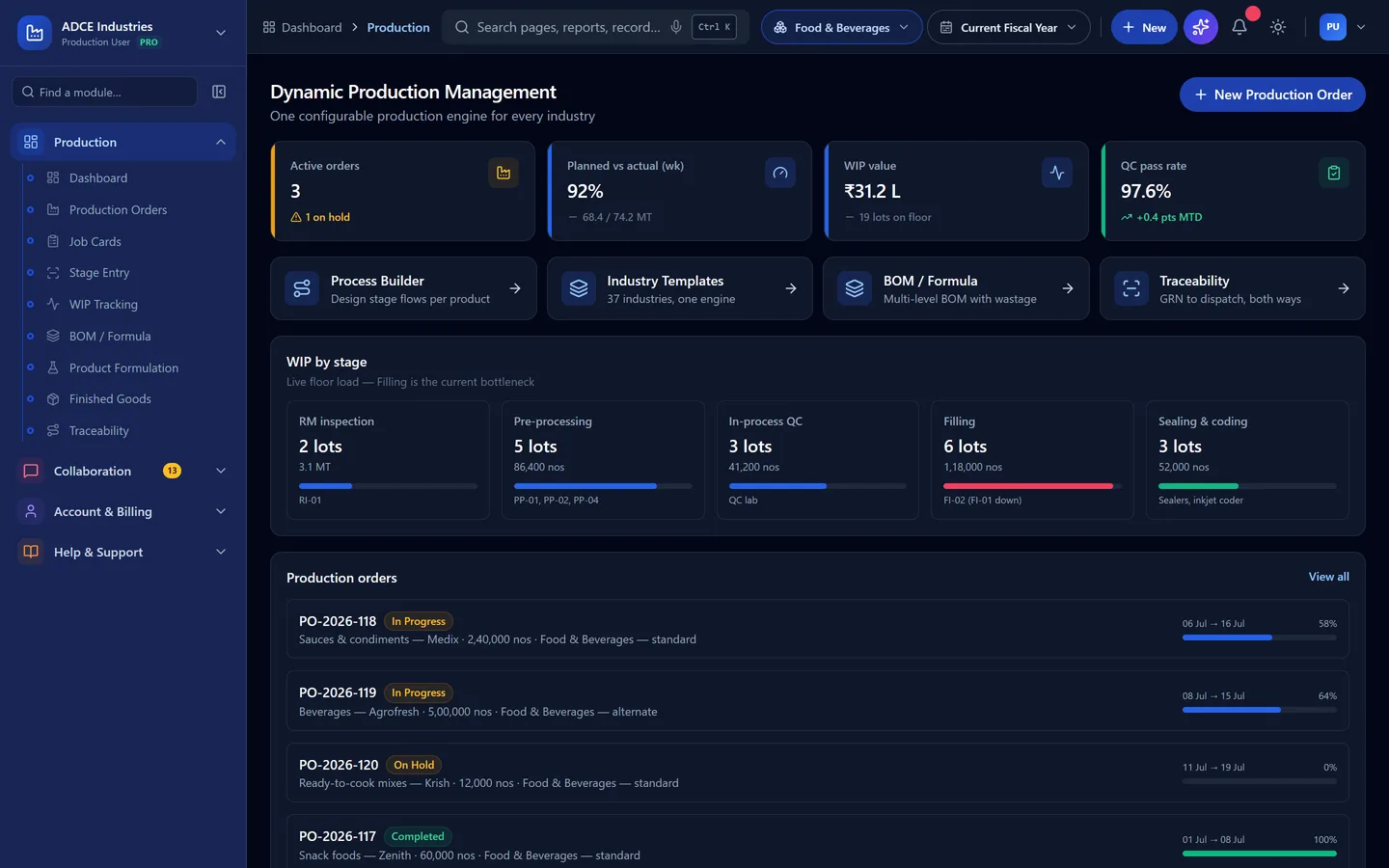
Recipe production with FEFO and hygiene checks. These are the stages the template ships with — machines and checks included. Yours will differ in detail; that is configuration, not development.
- 1
RM inspection
Check incoming ingredients for freshness, certificates and allergen segregation
- Machines
- QC bench
- Checked
- COA, organoleptic, moisture
- 2
Pre-processing
Sorting, washing, peeling and size reduction
- Machines
- Washers, cutters
- Checked
- Foreign matter check
- 3
Cooking / processing
Recipe-controlled cooking with time-temperature logging
- Machines
- Steam kettles, cookers
- Checked
- CCP temp log (HACCP)
- 4
In-process QC
Verify brix, pH, viscosity against recipe window
- Machines
- QC lab
- Checked
- Brix, pH, salt %
- 5
Filling
Hot/ambient filling into pouches, bottles or jars
- Machines
- Filling line
- Checked
- Fill weight, seal temp
- 6
Sealing & coding
Seal integrity plus MRP/batch/expiry coding
- Machines
- Sealers, inkjet coder
- Checked
- Seal test, code legibility
- 7
Cartoning
Secondary packing with shipper labelling
- Machines
- Manual/auto cartoner
- Checked
- Count, shipper label
What goes in
Ingredients with mfg/expiry batches
What comes out
Packed food SKUs
Sauces & condiments · Snack foods · Ready-to-cook mixes · Beverages
Who is it for
Not all food & beverage manufacturers work the same way.
The template is the same; what it has to answer for is not. Find the one that sounds like you — if none of them do, say so on the call and we will tell you honestly whether this is the right fit.
Packaged food & snack manufacturers
Recipe batches, shelf life and batch-code recall.
Beverage & syrup units
Blend batches, filling lines and returnable packaging.
Spice, flour & pulse mills
Seasonal buying, moisture-driven yield and grade-wise output.
Co-packers producing under someone else’s brand
Per-brand costing with the customer’s own labels and specs.
MANUPRIME AI
Ask it about this floor, in your own words.
The AI reads the same records this template creates — so on a food & beverage manufacturer floor the questions it can actually answer are the ones you already ask at the morning meeting.
Questions it answers here
- “Why has recipe yield moved this week?” — currently 96.1% in the demo data
- “Why has micro pass rate moved this week?” — currently 99.6% in the demo data
- “Why has giveaway (overfill) moved this week?” — currently 0.7% in the demo data
- “Where is my wastage going?” — process loss, line rejects, costed back to the batch that caused it
- “What am I short of in the next 14 days?” — with the covering purchase order drafted for approval
And what it is not allowed to do
It shows its working, or it does not answer
It drafts. A person releases
It sees only what the person asking can see
Quality
What quality control looks like here.
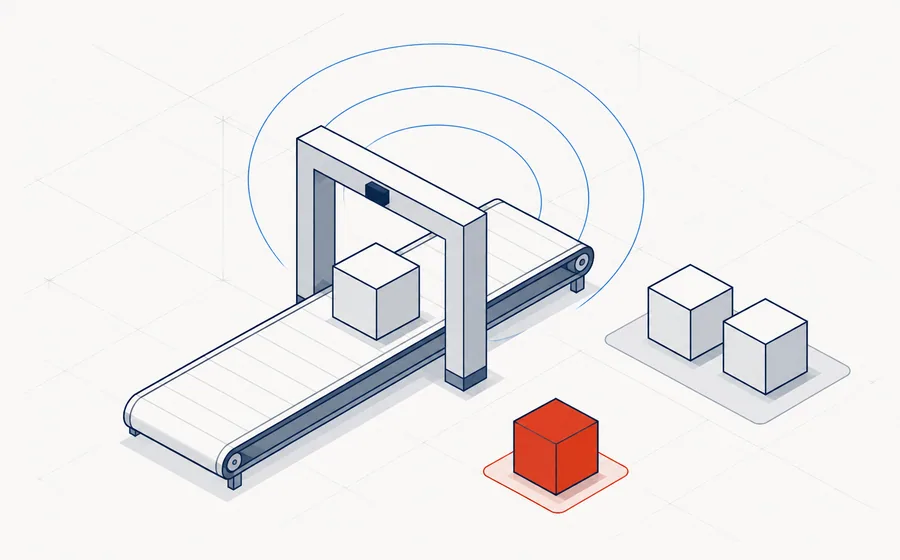
Checks that hold a dispatch, at the frequency this trade actually inspects.
| Parameter | Method | Frequency |
|---|---|---|
| CCP temperatures | Data logger (HACCP) | Continuous |
| Micro (TPC, coliform) | Lab culture | Per batch/lot |
| Net weight | Checkweigher | 100% inline |
| Seal integrity | Vacuum/dye test | Hourly |
Wastage and recovery
The part generic ERPs get wrong.
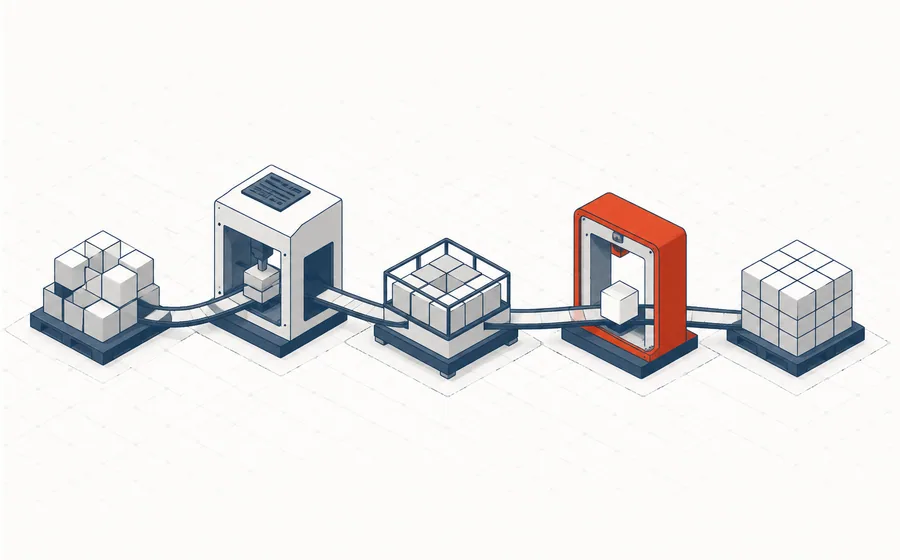
Most systems can only write material off. In this trade that is the difference between a costing you believe and one you argue with.
Rules that ship with this template
- Process loss standard 4% by recipe
- Line rejects segregated as animal feed / destruction with record
- Near-expiry FG blocked by FEFO for institutional sale
What drives your cost per unit
- Recipe yield variance batch-wise
- Seasonal RM price bands
- Energy per cooking hour
In short:Process loss, line rejects.
Compliance
What this trade has to prove.
Configured, not bolted on afterwards — the records come out of the same transactions your floor is already entering.
On the dashboard
The numbers this plant is judged on.
Sample figures from the demo, so you can see the shape of what you would be looking at every morning.
- Recipe yield
- 96.1%
- Micro pass rate
- 99.6%
- Giveaway (overfill)
- 0.7%
Illustrative values from the demo dataset, not a customer's figures.
Questions
Questions we get asked first.
Does it do FEFO picking on batches with expiry?
Yes. Picking suggests first-expiry-first-out by default, and shipping a batch out of order requires an override that is recorded against a user.
How fast is a recall?
Both directions from one screen: from a finished batch back to every ingredient lot, and from a suspect ingredient lot forward to every batch and every customer it reached.
Can it track process loss by stage?
Yes. Each stage records input and output quantity, so cooking loss, filling loss and line rejects are separate numbers instead of one lump at the end.
See it running with Food & Beverages data.
The demo opens with this trade's materials, machines, checks and reports already in place. No signup, nothing to install.