
MANUPRIME AI
An AI is only as good as the ledger underneath it.
Most factories do not have an AI problem. They have a stock figure nobody trusts, a job card on a whiteboard and a cost worked out afterwards in Excel. Put a model on top of that and you get a confident wrong answer faster. Get the record right first, and the AI has something worth reading.
- It reads your plant, not the internet — every answer comes from your own live records
- It cites what it read, with a link to the report behind it
- It drafts the purchase order, the schedule slot, the reminder; a person still releases it
- It runs inside your role matrix, so it cannot show somebody a number their role cannot see
You ask
What am I short of in the next 14 days?
Plain English, in the workspace. No report to find, no filter to set.
It answers from your data
Two shortages. White masterbatch — need 900 kg, have 240 kg + 300 kg on order → short 360 kg, stockout in ~2 days. Corrugated boxes 5-ply — short 2,200.
Every figure is a live record, and the answer links to the report it came from.
It proposes the work
Draft PO for 2 shortage items (₹4.1 L) — White MB from Colorant Masterbatch Co, boxes from Shakti Packaging.
L1 vendors, covering the 14-day MRP gap.
You approve
The purchase order opens as a draft for a person to check and release.
Approval limits still apply. The AI never signs anything.
Where it turns up
Not one chat window. Every screen that already holds a decision.
A copilot parked in a corner is a novelty. What changes a plant is the AI being present at the moment somebody is about to decide something — and reading the record that decision depends on.
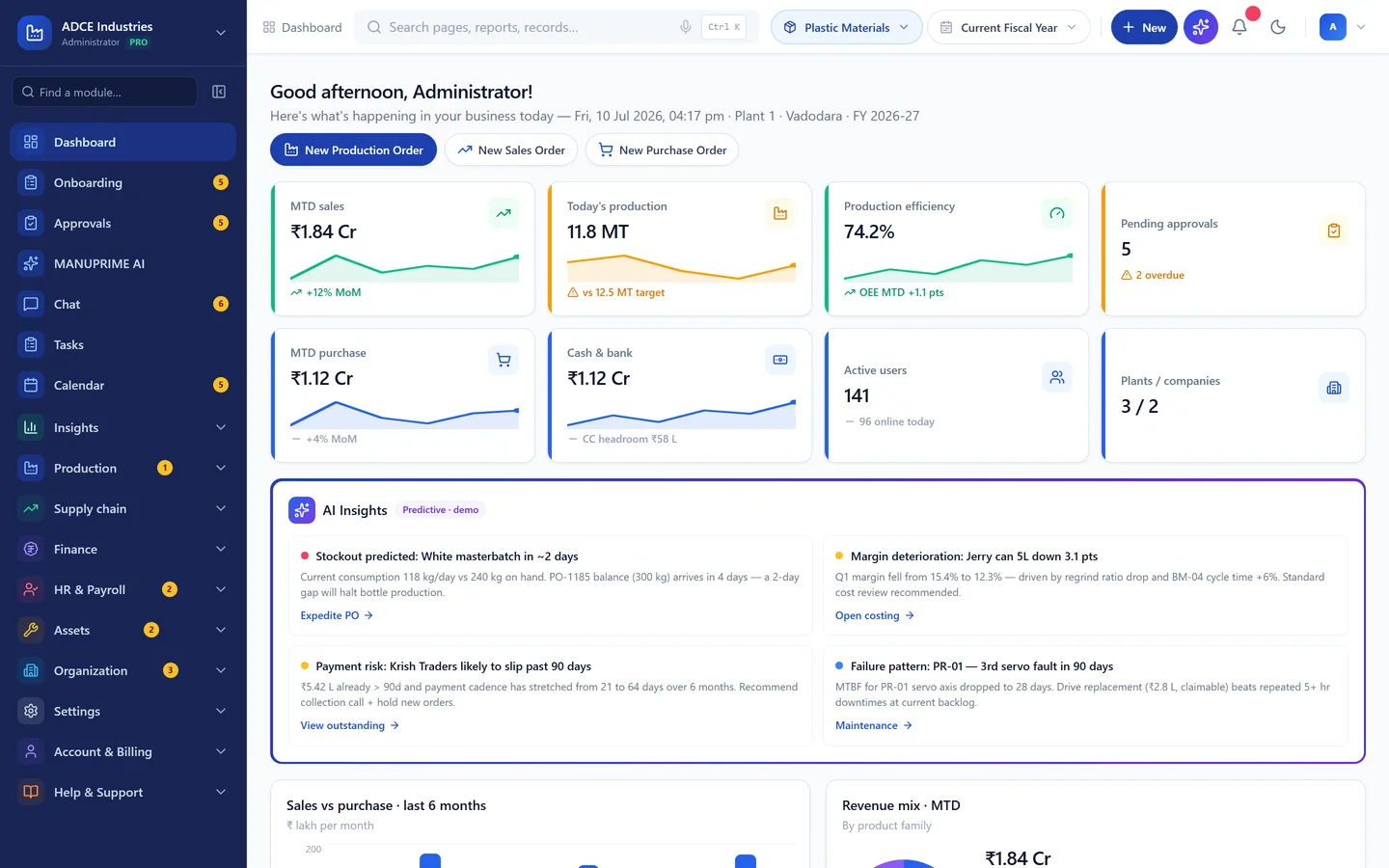
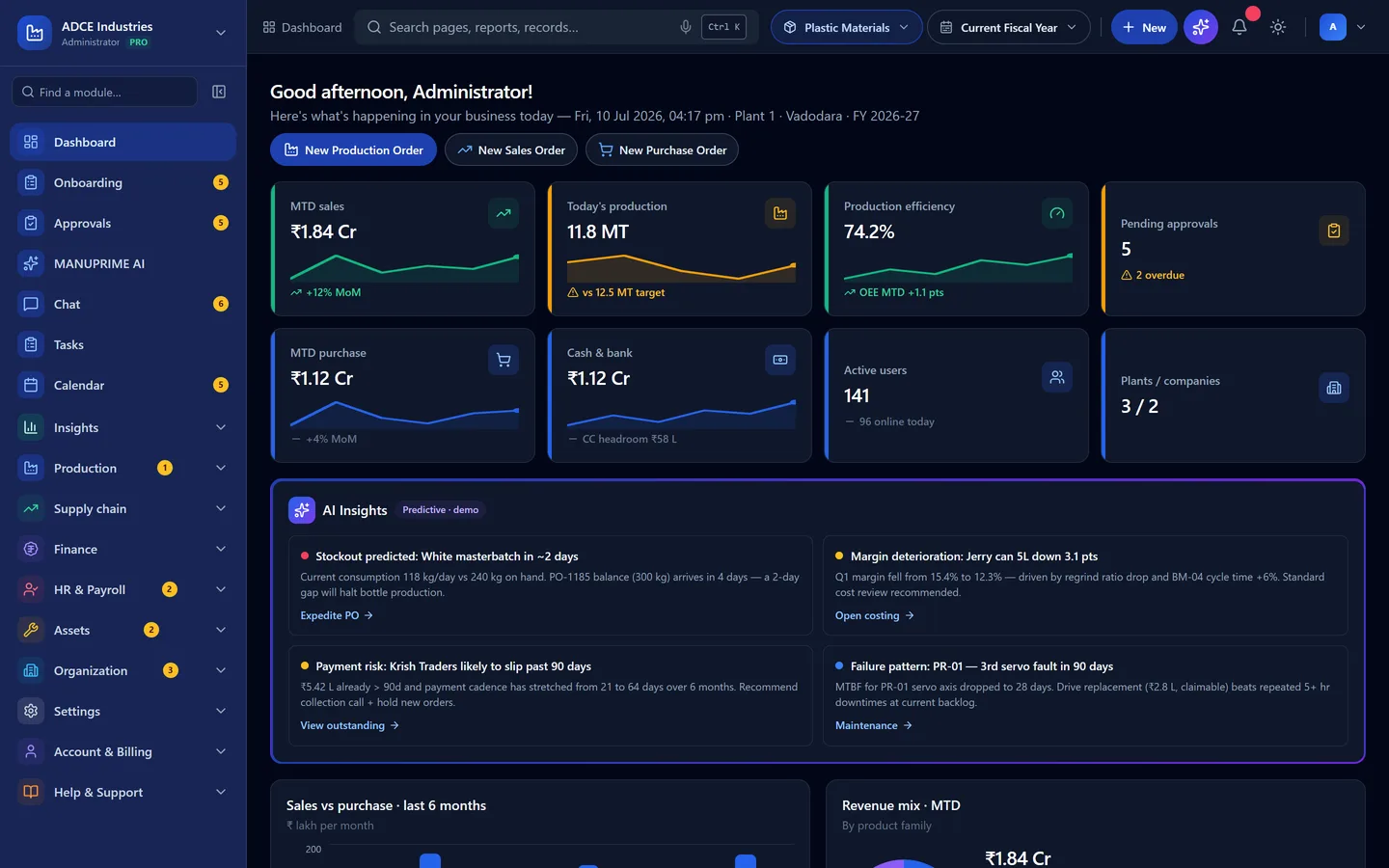
Flags a predicted stockout, a margin that has drifted, a customer whose payment cadence has stretched, a machine repeating the same fault.
Reads: Consumption history, standard cost versus actual, the receivables ledger and the breakdown log.
Proposes the schedule slot that fits without a shortage conflict, and explains what it displaced.
Reads: The MRP run, machine loading and the shift calendar.
Drafts the covering purchase order against L1 vendors when the material plan opens a gap.
Reads: Open orders, lead times, vendor rate history and landed cost.
Reads a defect from a line camera or an operator photo and raises the NCR with it attached.
Reads: Your inspection plan and its parameters — an add-on, priced per line.
Scores every enquiry hot, warm or cold, and drafts the quotation at a price the costing supports.
Reads: Won and lost history, current landed cost and the rate contract.
Reads vendor invoices, customer POs, certificates of analysis and transport documents into records instead of somebody typing them.
Reads: The document itself, matched against the PO it belongs to.
The rules
What it is allowed to do, and what it is not.
It shows its working, or it does not answer
Every answer carries the record it came from and a link to the report behind it. An assertion with no source is how a plant ends up trusting a number nobody can defend.
It drafts. A person releases
A purchase order, a schedule change, a payment reminder — all arrive as drafts in the approval queue, under the same value limits and delegation your people already work to. Nothing posts because a model was confident.
It sees only what the person asking can see
The AI runs inside the same role matrix as the rest of the product. A shift in-charge asking about margin gets the same answer the margin permission gives them, which is none.
Your data is never used to train a model
Not ours, and not a third party’s. Your production records, costs, customer names and drawings are used to answer your questions and nothing else. They are not added to a training set, not used to improve a model for anyone else, and not pooled with another customer’s data. Ask us to put that in the agreement and we will.
It is switched off until you switch it on
The copilot, insights, forecasting, document extraction and vision are separate line items you add when you want them. An ERP that quietly starts reasoning about your plant is not a feature.
Honestly
What it will not do for you.
Every vendor in this market is selling AI this year, ours included. The difference worth paying for is which of us tells you where it stops.
- It cannot fix a wrong master. If the BOM says 900 kg and the floor really consumes 1,100, the AI will confidently plan for 900 — the answer is only as good as the record.
- It does not run the plant unattended. There is no mode where production is scheduled, material bought and money moved without a person in the loop, and we are not building one.
- It is not a substitute for the first three weeks of getting your masters right. Every plant that has been disappointed by ERP was disappointed at the master data, not at the algorithm.
This is also why the 37 industry templates matter more than the model does. A template that already knows your stages, your quality checks and your wastage rules is what makes the record right in week three instead of month nine — and the record is what the AI reads.
What it costs
Priced as line items, because it is optional.
Ask-anything, insights and drafting come with the plans that include them; the heavier pieces are add-ons you switch on when you want them. Nothing here is bundled into a higher monthly rate you cannot see.
AI copilot seats
per user / month
₹499
Ask about production, stock, credit or compliance in plain language and get answers that cite the records they came from.
AI insights & anomaly detection
per month
₹4,999
Stockout prediction, margin drift, payment-risk scoring and failure patterns surfaced on the dashboard.
Included in dedicated
AI demand forecasting
per month
₹7,999
SKU-level demand from order history and seasonality, feeding the material plan.
AI document extraction
metered
₹2,999 + ₹1.50 per page past 2,000
Vendor invoices, customer POs, COAs and LRs read into records instead of typed.
AI quality vision
per month
₹9,999 per line
Defect detection from line cameras or an operator photo, raising an NCR automatically.
AI voice capture
per month
₹1,999
Shop-floor entry by voice in Hindi, Gujarati or English — hands stay on the machine.
Ask it something about a plant it has never seen.
The demo runs on real industry data. Ask about shortages, OEE or overdue customers on the call, and judge the answers yourself.