
Process / press
ERP for Plywood & Panel Manufacturers
A log is not a bill of materials. Recovery varies log to log, veneer sorts into three grades that feed three different products, and the panel is graded again after the press — so the yield question has to be answered four times, not once.
- Stages mapped
- 7
- Quality checks
- 4
- Wastage rules
- 3
- Compliance items
- 3
Your process
The stages, already mapped.
Peeling to pressing and sizing, graded at the end. These are the stages the template ships with — machines and checks included. Yours will differ in detail; that is configuration, not development.
- 1
Log peeling
Peel logs into veneer at the required thickness, tracking recovery per log lot
- Machines
- Peeling lathe
- Checked
- Thickness, veneer recovery
- 2
Veneer drying
Dry veneer to the moisture the glue line needs
- Machines
- Roller dryer
- Checked
- Moisture %, dryer temperature
- 3
Veneer grading
Sort veneer into face, back and core grades
- Machines
- Grading table
- Checked
- Grade split vs plan
- 4
Glue spreading
Apply resin at the specified spread rate within its pot life
- Machines
- Glue spreader
- Checked
- Spread rate g/m², pot life
- 5
Hot pressing
Press the lay-up at set pressure, temperature and time
- Machines
- Hot press, 15 daylight
- Checked
- Press cycle log, panel thickness
- 6
Sanding & sizing
Sand to thickness and trim to standard sizes
- Machines
- Wide-belt sander, sizing saw
- Checked
- Thickness tolerance, squareness
- 7
Grading & packing
Grade finished panels and pack them by grade and size
- Machines
- Grading bay
- Checked
- Surface grade, delamination check
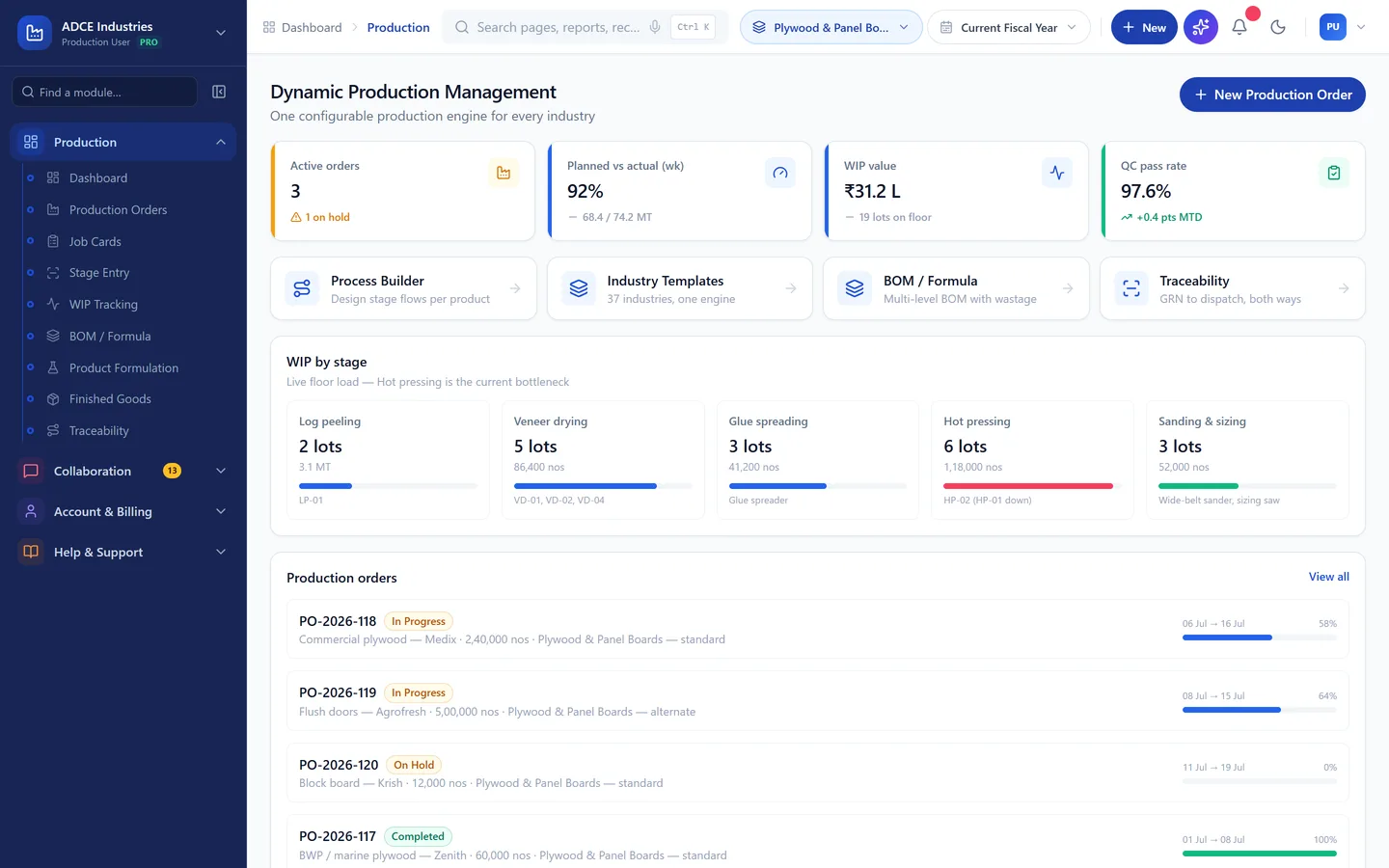
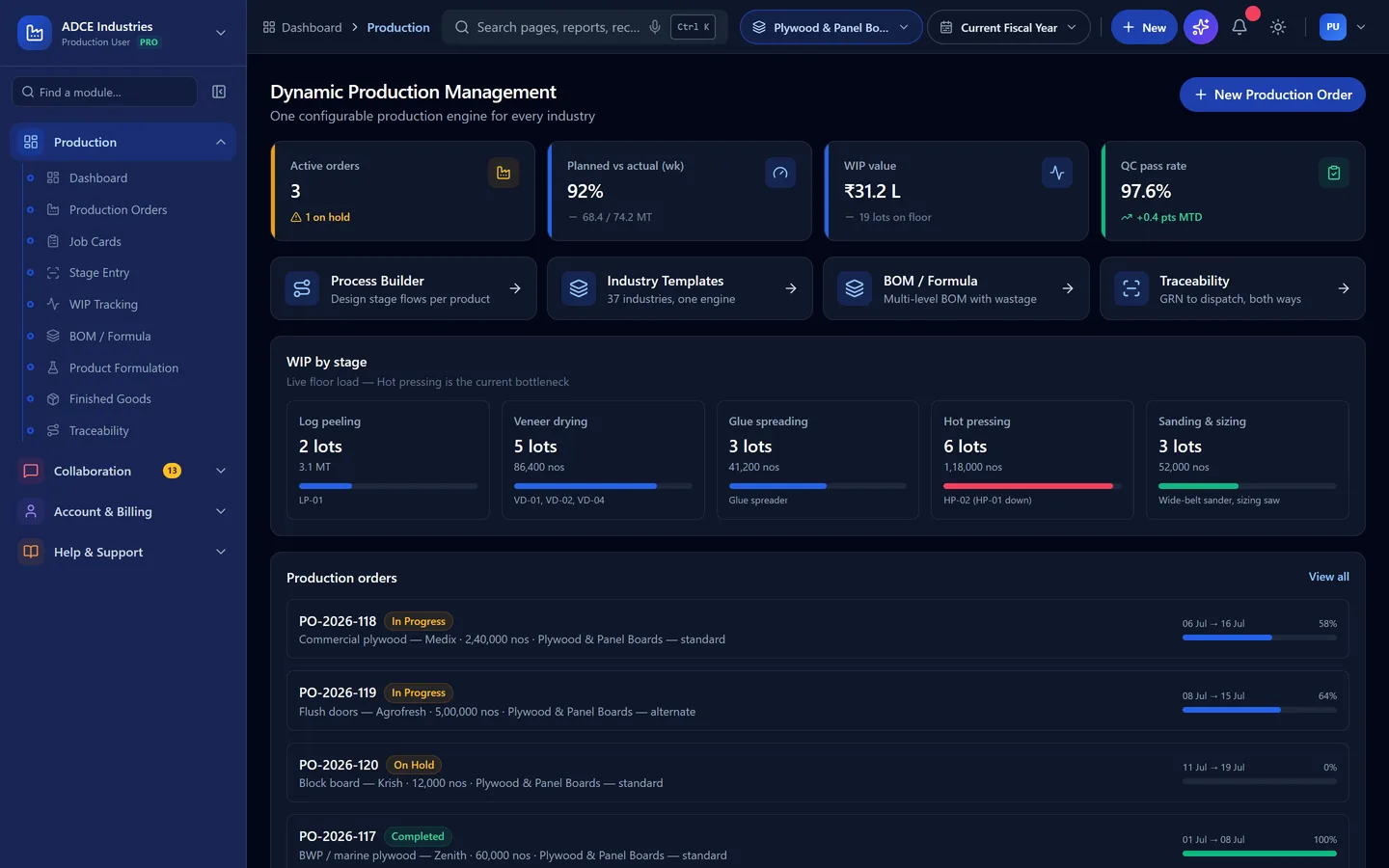
What goes in
Timber logs, resin, face veneer
What comes out
Plywood, block board, flush doors
Commercial plywood · BWP / marine plywood · Block board · Flush doors
Who is it for
Not all plywood & panel manufacturers work the same way.
The template is the same; what it has to answer for is not. Find the one that sounds like you — if none of them do, say so on the call and we will tell you honestly whether this is the right fit.
Plywood & blockboard manufacturers
Press cycles, glue consumption and grade-wise sorting.
Veneer & peeling units
Log-to-veneer yield and moisture-driven losses.
Laminate & panel processors
Sheet optimisation and edge-banding on bought-in board.
MANUPRIME AI
Ask it about this floor, in your own words.
The AI reads the same records this template creates — so on a plywood & panel manufacturer floor the questions it can actually answer are the ones you already ask at the morning meeting.
Questions it answers here
- “Why has veneer recovery moved this week?” — currently 62% in the demo data
- “Why has press rejects moved this week?” — currently 3.4% in the demo data
- “Why has grade-a output moved this week?” — currently 71% in the demo data
- “Where is my wastage going?” — core wastage, press rejects, edge trim, costed back to the batch that caused it
- “What am I short of in the next 14 days?” — with the covering purchase order drafted for approval
And what it is not allowed to do
It shows its working, or it does not answer
It drafts. A person releases
It sees only what the person asking can see
Quality
What quality control looks like here.
Checks that hold a dispatch, at the frequency this trade actually inspects.
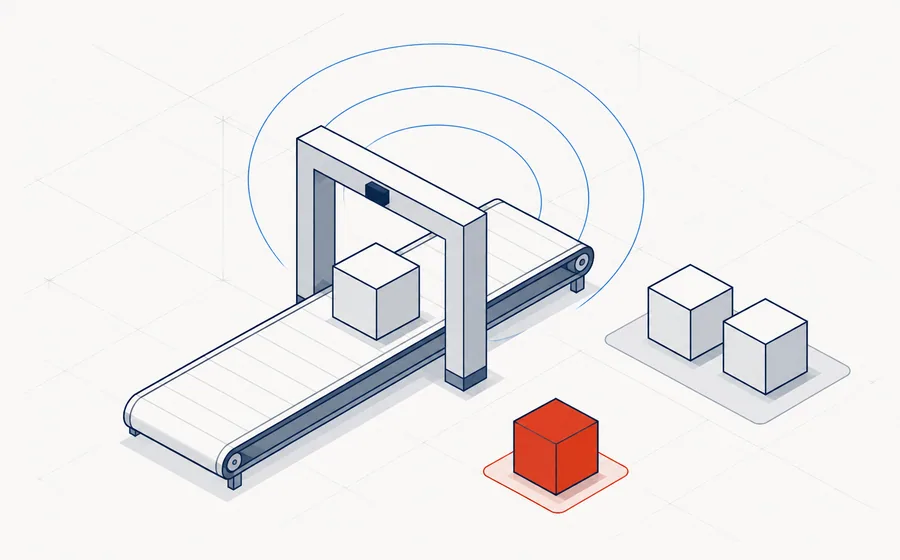
| Parameter | Method | Frequency |
|---|---|---|
| Moisture | Moisture meter | Every dried batch |
| Glue shear | Boiling water test | Every press lot |
| Thickness | Micrometer | Every panel lot |
| Delamination | BWP cycle test | Per grade lot |
Wastage and recovery
The part generic ERPs get wrong.
Most systems can only write material off. In this trade that is the difference between a costing you believe and one you argue with.

Rules that ship with this template
- Core wastage standard 12% of log input, with patched veneer counted as recovery
- Press rejects downgraded rather than scrapped where the defect allows it
- Edge trim and sander dust booked as recoverable and sold as fuel
What drives your cost per unit
- Log cost per cubic metre against actual veneer recovery
- Press-hour rate including heating
- Resin cost per panel at the actual spread rate
In short:Core wastage, press rejects, edge trim.
Compliance
What this trade has to prove.
Configured, not bolted on afterwards — the records come out of the same transactions your floor is already entering.
On the dashboard
The numbers this plant is judged on.
Sample figures from the demo, so you can see the shape of what you would be looking at every morning.
- Veneer recovery
- 62%
- Press rejects
- 3.4%
- Grade-A output
- 71%
Illustrative values from the demo dataset, not a customer's figures.
Questions
Questions we get asked first.
Can it track recovery from log to panel?
Peeling recovery per log lot, veneer grade split, press yield and final grading are four stages with four numbers. A bad month is traceable to the stage it happened at rather than blamed on the timber rate.
How is a downgraded panel handled?
As a co-product at its own value, not as scrap. A panel that misses face grade is still a saleable panel, and its cost follows it — so your grade-A cost is not inflated by material you actually sold.
Does it handle the resin spread rate?
The spread rate is a costed BOM norm with an actual against it per press lot. Glue is one of the two things that decide the margin, and it is the one nobody measures.
See it running with Plywood & Panel Boards data.
The demo opens with this trade's materials, machines, checks and reports already in place. No signup, nothing to install.