
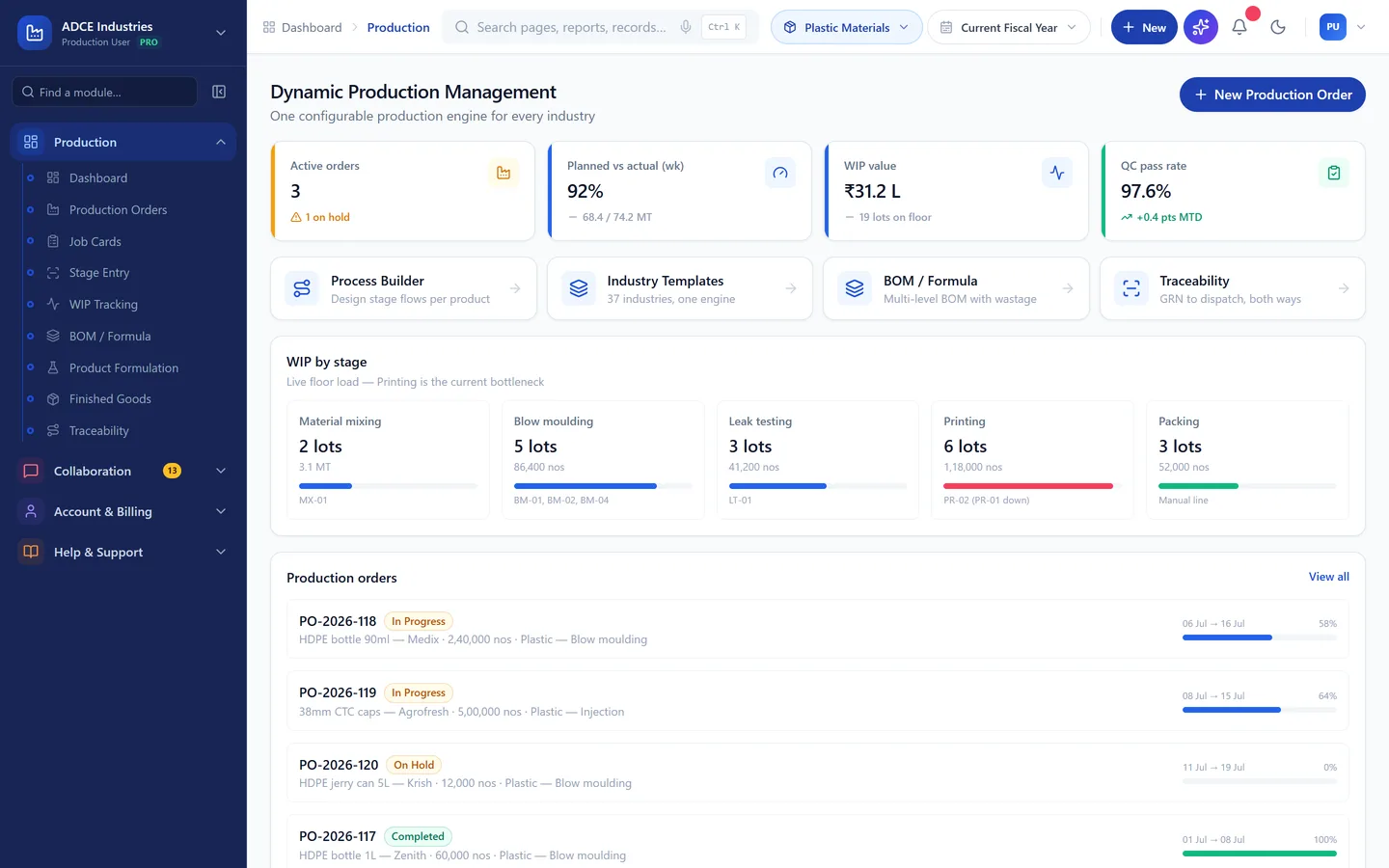
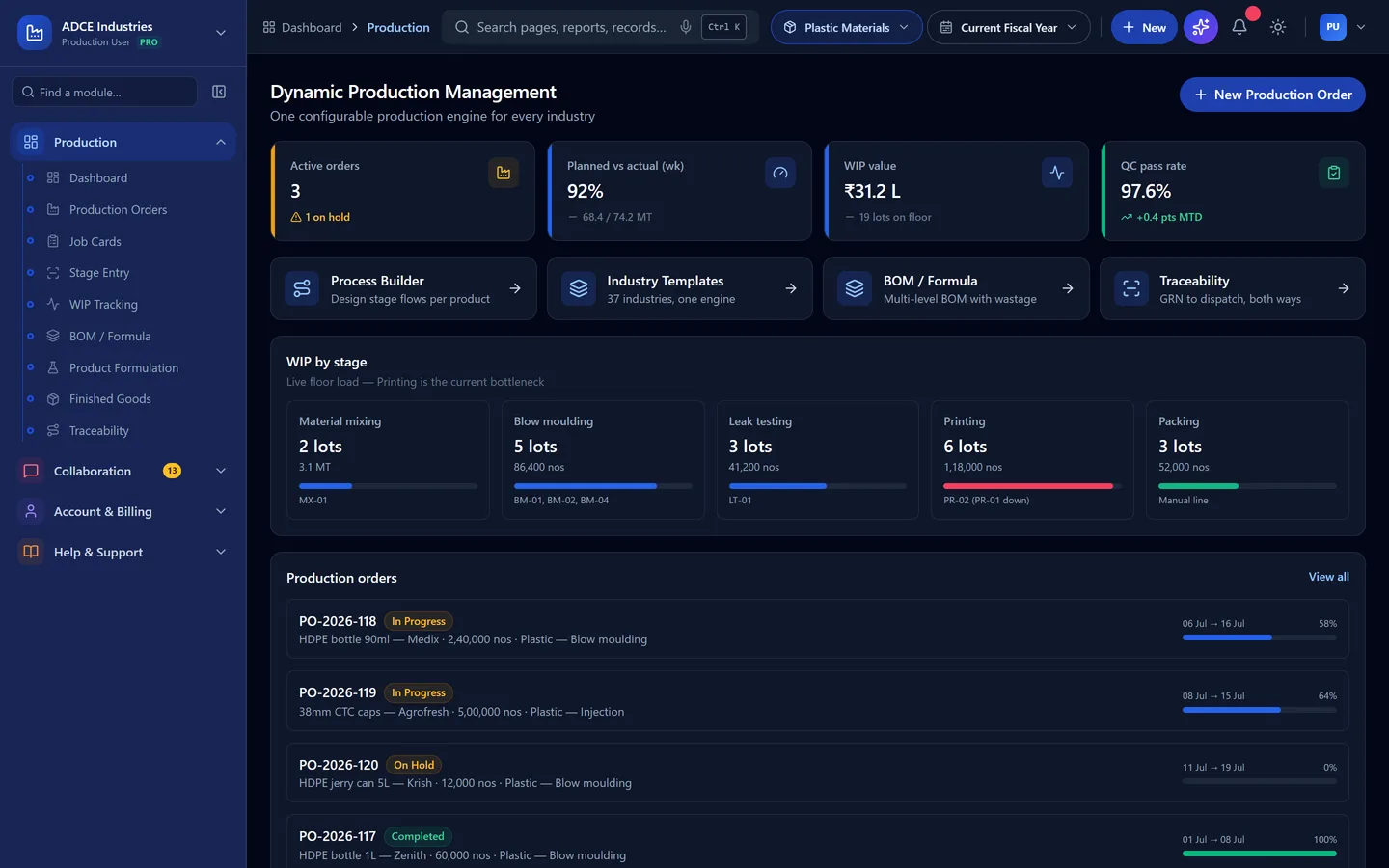
Process / moulding
ERP for Plastic Manufacturers
Startup lumps, runners and rejects come back as regrind with real value. Most ERPs can only write that off, which is why moulding shops end up costing on a spreadsheet.
- Stages mapped
- 6
- Quality checks
- 4
- Wastage rules
- 3
- Compliance items
- 3
Your process
The stages, already mapped.
Mixing, moulding, decoration and packing. These are the stages the template ships with — machines and checks included. Yours will differ in detail; that is configuration, not development.
- 1
Material mixing
Blend virgin granules, masterbatch and regrind to recipe percentages
- Machines
- Mixer MX-01
- Checked
- Blend ratio check
- 2
Blow / injection moulding
Convert blended material into containers or components
- Machines
- BM-01…04, IM-02
- Checked
- Weight, wall thickness
- 3
Deflashing
Remove flash and necks; route trimmings to regrind
- Machines
- Manual station
- Checked
- Visual finish
- 4
Leak test
100% pressure-decay leak testing of containers
- Machines
- LT-01
- Checked
- Leak pass/fail
- 5
Printing
Dry-offset print up to 6 colours with registration control
- Machines
- PR-01, PR-02
- Checked
- Registration, adhesion
- 6
Packing
Carton packing with polybag liner and batch labelling
- Machines
- Manual line
- Checked
- Count, label, drop test
What goes in
Granules, masterbatch, regrind
What comes out
Bottles, caps, containers
HDPE bottles 90ml–5L · Caps & closures · Jerry cans · Custom blow/injection components
Who is it for
Not all plastic manufacturers work the same way.
The template is the same; what it has to answer for is not. Find the one that sounds like you — if none of them do, say so on the call and we will tell you honestly whether this is the right fit.
Injection & blow moulders
Cavity-wise output, cycle time and regrind ratio per shot.
Extrusion units
Continuous runs measured in kilos, not pieces.
Masterbatch & compounding units
Formula batches with colour and dispersion checks.
MANUPRIME AI
Ask it about this floor, in your own words.
The AI reads the same records this template creates — so on a plastic manufacturer floor the questions it can actually answer are the ones you already ask at the morning meeting.
Questions it answers here
- “Why has oee (plant) moved this week?” — currently 74.2% in the demo data
- “Why has rejection rate moved this week?” — currently 1.2% in the demo data
- “Why has changeover time moved this week?” — currently 38 min in the demo data
- “Where is my wastage going?” — startup lumps, runners → regrind, costed back to the batch that caused it
- “What am I short of in the next 14 days?” — with the covering purchase order drafted for approval
And what it is not allowed to do
It shows its working, or it does not answer
It drafts. A person releases
It sees only what the person asking can see
Quality
What quality control looks like here.
Checks that hold a dispatch, at the frequency this trade actually inspects.
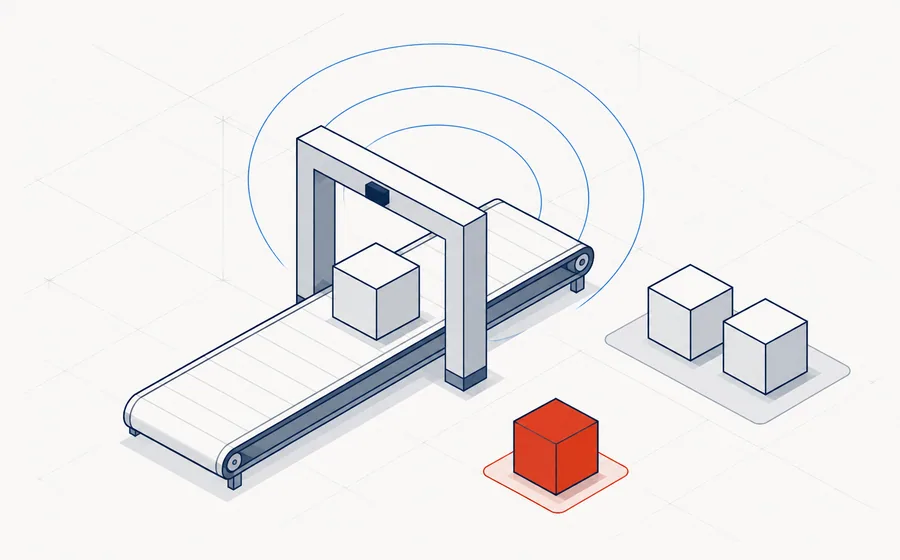
| Parameter | Method | Frequency |
|---|---|---|
| Unit weight | Balance ±0.1 g | Hourly per machine |
| Wall thickness | Magna-Mike gauge | Per setup + 2-hourly |
| Leak | Pressure decay | 100% inline |
| Print adhesion | Tape test | Per print setup |
Wastage and recovery
The part generic ERPs get wrong.
Most systems can only write material off. In this trade that is the difference between a costing you believe and one you argue with.
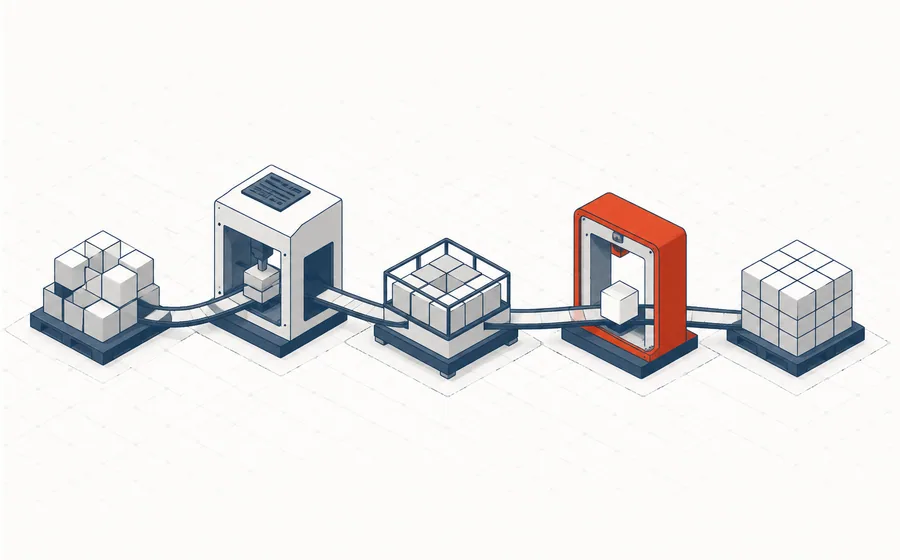
Rules that ship with this template
- Startup lumps & necks 1.2% → regrind (18% blend-back cap)
- Print rejects 0.8% → scrap sale with TCS
- Colour-change purge weighed per changeover
What drives your cost per unit
- Machine-hour rate per tonnage class
- Regrind credit at 45% of virgin cost
- Mould amortisation per shot
In short:Startup lumps, runners → regrind.
Compliance
What this trade has to prove.
Configured, not bolted on afterwards — the records come out of the same transactions your floor is already entering.
On the dashboard
The numbers this plant is judged on.
Sample figures from the demo, so you can see the shape of what you would be looking at every morning.
- OEE (plant)
- 74.2%
- Rejection rate
- 1.2%
- Changeover time
- 38 min
Illustrative values from the demo dataset, not a customer's figures.
Questions
Questions we get asked first.
Does regrind come back into stock at a value?
Yes. Runners and startup waste are received as a recovered material with their own rate and can be dosed back into the next mix at a permitted percentage. The BOM knows the limit.
Can it hold different cavity counts and cycle times per machine?
The routing is per machine, so the same part moulded on a 150-ton and a 250-ton machine carries its own cycle time, cavitation and machine-hour rate. Costing follows the machine it actually ran on.
How is masterbatch dosing tracked?
As a BOM component with a dosing percentage, consumed against the shot weight rather than issued in round kilos. Colour changeover loss is captured as its own wastage reason.
See it running with Plastic Materials data.
The demo opens with this trade's materials, machines, checks and reports already in place. No signup, nothing to install.